

⋆。˚ Cherry menthol inside, I find You hiding in my bedside pocket ⋆.🜼

Good morning y’all,
This morning I am at a Starbucks in Pantops, channeling my inner John Green, "I wrote most of The Fault in Our Stars at the Starbucks on the corner of 86th and Ditch." (If you click on the link, go to the question that reads: "Was there a reason that you chose your hometown as the setting for TFIOS?") I have this morning off of work which is unusual and so I am going to try a new church that my coworker, Audrey, told me about. She goes there and she says that she really loves it. I’ve tried a few different churches in Charlottesville and I just haven’t found the one that quite fits yet, but I am optimistic about this one.
God keeps showing up! I got a letter in the mail the other day, not addressed to me, just to the “current resident” of my apartment and it was someone telling me about Jesus. I think it’s all been there the whole time, it’s just been waiting for me to look.
I got to Starbucks around 5:45 because I got home from work last night, ate some salmon, rice, and green beans that were a mess up so I got them for free, and then I fell asleep on my couch with all of the lights, the TV, and my glasses on. No, I also didn’t even make it to the shower! Yesterday was literally so busy that I felt like I fell into a coma the second my belly was full and I put my feet up on that couch. By the end of the night at work I wholeheartedly tried to say the word “toxic” to my coworker and it came out slurred as “toxis.” I needed to go to bed. So then this morning, I woke up at 5 am with my glasses on in the exact same position I was in when I laid down haha. I’m glad I didn’t move because I was immediately nervous that I bent my glasses, but they were all good! I did finish Sweet Home Alabama before I fell asleep though and I have now added that to my list of rom coms that I really like.
This morning I kind of just wanted to share an update of what I’ve been working on this semester. While last semester was very English Lit heavy, this semester is more pedagogy heavy, and I am reading a lot of research on best teaching practices, literacy, and classroom management strategies. I am really, really enjoying it. It is about the same amount of reading; however, I am doing different types of assignments than I was doing last semester. Whereas before I was writing very abstract, conceptual papers for the most part, this semester I am working on lesson plans, classroom behavior plans, and creating syllabi. I am absolutely, absolutely loving it. It’s just as challenging in some ways. Just like I had never written in the style that I was expected to with my seminar papers, I have also never created lesson plans from scratch, matched them with state learning standards and objectives, or scaffolded assignments for my own writing class. I am being challenged just in a different way now, in a way that I need in order to be a good teacher in a short year and a half, and in a way that is affording me so, so many opportunities for growth and curiosity. I am still in one English Lit class – “American Wild” – and that has been the perfect class to intermix with my other three Education courses. I do have an assignment coming up for that one. I think that over spring break when I am back home in Indiana I am going to work on putting that one together. The part of the assignment I will be working on is a short, memoir-like essay about memories from my childhood that have entwined themselves with a sense of Indiana nature and wildness.
I have talked about it before a bit, that Indiana and Virginia both have their own kinds of nature and "wild". Nature is a spiritual thing, you know? And in my heart nature feels different both in Indiana and here; I think so much of Indiana nature has laced itself with memories I have has a child and a young person that those images in my memory now serve as a vignette of untamed wildness, not only adolescence, but also the big, untamed, overflowing love that I have for my people in Indiana.

That feeling of love is tied to the Sycamore tree I used to climb with my brother, the peach and apple trees in my grandparents yard, the raspberry bushes that gave way to my mom’s black raspberry cobbler, my bug collection as a child, and the Killdeer that I would hear during the warmest part of the summer when I would ride my bike to the creek down the road from my house. It’s not nostalgia that makes me remember those times more fondly because in the moment, I knew what I had. I remember them because I was so present in them that they imprinted on me the sounds, the smells, the physical feelings of experiencing those things, and I feel like nostalgia implies a degree of sadness, or maybe a configuration of a retrospective image that bears some amount of regret. I don’t know, maybe I’m wrong about that. I’m nostalgic sometimes for high school, but I don’t necessarily have regrets about it when I feel that way. So, maybe I just disproved my own point. Basically, I think what I actually meant was just sadness, not regret – nostalgia implies a degree of sadness. And I think I do feel sad about those memories in some way, maybe like grief.

Those memories are something I can live in kind of like, how I talked about a while ago, literature is also something that we can live in. Nature is a reflection, Nature is her own – not something for us to insert ourselves in, but memories of Nature – those are something for me to fill up with my love. I know I kind of did a full pivot during that paragraph, just bear with me. It’s actually a good example of what I’m going to talk about later: “writing as inquiry” and writing without an answer in mind, more writing to ask questions and discover. In the end, my idea is that my assignment will be a collective-memoir type of thing that captures images of wildness and nature from my childhood, written in a sort of Emersonian style that really embodies his “transparent eyeball” and maybe, possibly will affect some sort of aphoristic tone.
For my other classes I am working on a syllabus, lesson planning, and classroom management plans. (By the way, the vocab lesson, the Quad-Text Set, and the Management Plan I’m about to talk about are hypothetical because they’re designed around Indiana 11th grade ELA standards. They are plans I can and hope to use in the future, but they won’t be things I use at UVA. The syllabus, though, will be used for my ENWR class at UVA.)
This week I created a vocabulary lesson. Background on how I came to use the specific text for the lesson is that, probably 3 weeks ago, I had to submit a Quad-Text Set where I chose a target text that would be my main, enriching text for an ELA unit. The unit meets specific Indiana learning standards for 11th grade English. For the target text I chose Maus by Art Spiegelman, which is a book that I read in my L260 “Intro to the Advanced Study of Literature” class at IU. That was the second class that I took with Professor Charnes who is absolutely a celebrity on this blog and who I have mentioned before. I’ll attach my notes from that class in case anyone ever reads it, has read it, or is just curious and wants to see the kind of absolute banger knowledge that that woman was imparting on all of us. I took the notes by hand, but my mom has my copy of Maus right now and I typed them out so that she can follow along with the notes while she reads it if she wants.
I chose Maus because I felt like she taught it so well and if I can use my notes to recreate even a fraction of what we talked about in that class, my students will walk away from the unit with an understanding of a Holocaust experience, the significance of how a story ends and what that means for the characters involved, the historical use of archetypes (Maus is a graphic novel, so a lot of the archetypes are visual), and a firm understanding of key vocabulary words in a nonfiction setting. That means the unit would be CROSS-CURRICULAR WITH HISTORY STANDARDS OH YEAH. Additionally, for the Quad-Text Set (which is actually 5 texts), I chose two informational texts to build background knowledge, one visual text (John Green’s “Crash Course: World History” on WWII), and another graphic novel: Anne Frank's Diary: The Graphic Adaptation.
For the vocabulary lesson I worked with the first informational text that my students will read, which is Introduction to the Holocaust by The United States Holocaust Memorial Museum. (Side note: I visited The Nancy and David Wolf Holocaust & Humanity Center with my mom a couple of summers ago on a girls trip. It's not the same museum, but it's in Cincinnati and it was a very worthwhile trip.) I chose words from the text that will be important for students to know in order to progress through the unit. Learning how to scaffold lessons while accounting for the varying levels of prior knowledge that students will bring to the table has been challenging; it’s even more challenging without having actually been in a high school classroom much. I don’t feel like I have a good gauge as to what the average level of comprehension or general knowledge base is, and numbers given throughout the research material can only tell me so much, but all of this is definitely something that I will have to be flexible with when it comes time to actually implement and use it. I wrote up a rationale for the words I chose which I will spare you, and then I created a chart based on one of the learning strategies I read about. A lot of the literature I have been reading is centered around the Science of Reading. A lot of best teaching practices, I think, come down to common sense. However, figuring out how to actually execute those skills and objectives is the hard part. Also accounting for the cognitive science behind all of it is something that I will need to have a strong understanding of in order to be effective. Who would have ever thought I would be studying science? Not me! But I am loving it.
I chose to make a Probable Passage Chart for the vocab, and I brainstormed with my mom a bit when I was thinking about how I actually wanted the activity to run.
I am very excited about it because it is a synthesis of a lot of the literature I have been reading. I’ve learned that often times it is best to work backward when creating lessons. Honestly, teaching is a lot of moving backward to move forward and I like that. Within the vocab lesson some of my reasoning is built on research from my Classroom Management Plan. I’ve been learning a lot about Social Emotional Learning which, contrary to what some people in Whitley County have tried to say, is different than Critical Race Theory! CRT has a place in schools, and definitely at universities. It’s not something that I’m going to be allowed to explicitly teach per Indiana guidelines I don’t think, but I want to be on record saying that it is important. SEL is research backed and focused on developing the whole student by designing lessons and creating a classroom environment that is accessible and positive for all students. This could look like providing multiple means of expression and action in the classroom, multiple and diverse representation in the classroom, and multiple opportunities for engagement to include all learners. By doing so, statistically, student performance increases and disruptive behaviors in the classroom decrease. I tried to account for this (which can be seen in the document) by providing multiple opportunities for students to respond and multiple ways for them to engage with their peers. As we speak, I am receiving feedback from my classmates on it – many of them are already teachers who are actively teaching in Virginia and I feel very lucky that I have the opportunity to work with them and honestly use their experience as another resource from which to learn.
In another class on Writing Pedagogy, something else I have been working on is my syllabus for ENWR in the fall. So far, we have covered course description, student resources, and (vaguely) teaching practices. I will technically be an instructor, kind of like a TA except I am designing the course not just facilitating someone else’s. My course description, per comments from my professor, needs to be simplified a bit. He said it reads more as an upper level course which makes sense given that for the past 5 years that is the environment that I have been subject to at university. I’m going to put it here anyway to give y’all a general idea of what I’m hoping the course will be.
“In this course we will curiously approach some of the most harrowing accounts of our shared human history, both real and fictionalized, that somehow, through the darkness they detail, offer us far more – spiritually, morally, emotionally – than what is merely written on the page. How is it they are able to do this? In this course we will explore questions of morality, strength, dehumanization, and resilience. We will consider the grit and resilience of specific authors and diverse groups of people throughout our shared human history and think through critical lines of inquiry, such as: What does the resilience of others require of us as readers? How do humans persevere through such unspeakable acts of horror? What is the importance of writing for othered groups of people? How does one convey such emotions through writing?
Together, we will take a multimodal approach to exploring texts that will help up foreground these lines of inquiry. We will consider primary sources such as personal essays written by interned Japanese-Americans during WWII, video documentaries such as the Slave Narratives from the Federal Writers' Project, and an illustrated graphic novel, Maus by Art Spiegelman, that each considers and portrays human resilience differently. Our goal is to treat writing as a form of inquiry, a way in which we can ask the questions these stories deserve, while also serving as a vehicle through which we all may explore our own kinds of resilience. Assignments for this course will include 3 essays that demonstrate the student's ability to reflect, analyze, and think on the page, edit, peer-review and communicate effectively with classmates, and engage with sources across multiple texts.”
So that’s the gist of it and now my task is to come up with a draft of what the 3 main writing assignments will be for the class. Okay, I am so excited about this because we are utilizing this new model of inquiry for the class. I believe they’re calling it the Consider-Connect-Contend Model. Well, I know they’re calling it that, I guess what I’m unsure of is where it’s come from. I think that the faculty member who will be the Director of Graduate Teaching next semester pioneered it, but I also vaguely remember the University of Pittsburg being a name that was thrown around. It may have come from there or been inspired by something in their writing program. Regardless, that is the model we are using. The Connect essay will probably be what I assign first, asking students to engage with course readings while writing a narrative essay of some sort. The second will be the Consider essay. This one steps up a tad in complexity as it asks students to consider two or more of our course texts and identify which features they find most effective or ineffective and consider how that may translate into their own writing practice.
The last essay, Contend, will be the most complex. It will ask students to (my words) “level with the text,” essentially bringing an original thought to a problem / question / idea that interests them and contribute to a larger discussion of one of the themes that we will deal with throughout the course. Let’s get into the semantics of this because I thoroughly enjoyed class last week solely based on the fact that for about 20 minutes we all discussed the difference between “argue” and “contend.”
One of my classmates pointed out that in the example assignment description that we all got to take a look at, “contend” kind of just sounded like “argue.” Which is true, the difference is minute and at first glance it really is like, "Oh, so I'm supposed to make an argument." Contending with a text or an idea is not something that is learned over night. Honestly, it’s not something that can be developed in one class; over time through trial and error contending kind of just happens for writers I think. The more comfortable and familiar you get with your interests, your voice, your contextual knowledge and understanding of not only writing, but what conversation you’re entering into, contending becomes less clunky and a little more natural. I know she knows that which is why she pointed it out; she was more drawing attention to the fact that the language needs to be unambiguous in order for students to understand what we're asking of them.
"So what actually is the difference between 'arguing' and 'contending'?" you may ask...
In my experience, the first year writing course that I took at IU was W170: "Intro to Argumentative Writing." I will use this as the base point for my example. What we were to do was “write analytical, argumentative, and investigative academic essays,” which did serve me well. A lot of the texts I read in that class are foundational to a lot of the disciplinary writing I do today. The essay I rewrote and submitted as my writing sample for my UVA application actually was my final essay for that class, but what the revision process required of me, and why I think my essay was well-received, was because I changed the entire structure of the essay from arguing to contending. I rewrote the essay changing it from a thesis driven argument to a paper that, instead, explored how a specific part of the text was working and what this may suggest about the larger social context of the play. Instead of proving X, I gathered evidence and made a case for something new, decided on a name for the new thing I was thinking of, and then suggested why and how it may be relevant to further study of the play today. In essence, I think arguments are more stringent whereas contentions are more, "Hey, this is what I have noticed and this is what I think about it."
In class my professor brought up that typically as soon as you (or students in general) hear the word “argument” you’re already plugging things into a formula. We're trying to move away from that for the purposes of this class. There is a way to argue just like there is a way to contend, but contending with something on a basis of inquiry is more flexible. It is thinking on the page, more kinetic than a basic argument. I naturally sort of started doing that in my later years at IU, but I started doing it because it felt fun and interesting to me. It also felt tenuous because I was / am so young and new at writing. Last semester was the first time I had really been assigned a task that required me to contend, and without the proper supports (because I was in literature classes not writing classes) I really, really struggled with doing it succinctly. I think it is so amazing that we are introducing contention to students in their first year. Arguing is an important skill, yes. But I think students have a lot of practice arguing. I remember doing that in high school. Asking students to contend, to treat writing as a space where they can ask questions and formulate their own thoughts about a topic rather than pulling quotes from a text to simply prove a foregone conclusion is a skill that I think will be not only enjoyable, but worthwhile for their education. It requires students to think without an end point – to step away from a thesis driven paper – and instead explore where their interests lie.
One thing as well that I thought was incredibly smart was that on the example assignment sheet we were looking at, for the first part of the essay the professor asks students to contend with a text (or texts) as a result of their experience with _____. (His class was about work, so he said: “form of work,” but it could be anything when thinking about it more generally like we are.) The second part of their task is to “compare your experience with that of any writer we read during this unit of the course.” From this, students find their “kernel” as I was taught, the thing that they center in on to offer some sort of new knowledge or perspective. I really liked how he encouraged students to draw from the first person “I” in order to have a foundation for their thinking. Asking someone to write about what they know is a strong entry point for an assignment, and what better do students know about than their own experience? That stuck out to me because in my seminars when I "Contend” I am expected to contend with theory or whole genres, eras, and corpuses – it’s incredibly overwhelming, dense, and hard to do. His design makes the Contend essay more accessible for first year students.
I am so excited to see how these things may translate into my ENWR course in the fall. I am heading back to Indiana for spring break at the end of this week. It will be nice to see my family and my friends for a bit. I am also making a capital "W" Woman move and not letting an opportunity get "taken off my plate" as Dwayne likes to say. YES, OKAY I have a crush and I'm going to (kind of) say it in the form of a mature, read between the lines message on none other than Linked In. I don't know, man. Why not, right? What's the worst that could happen? We will see!
xx
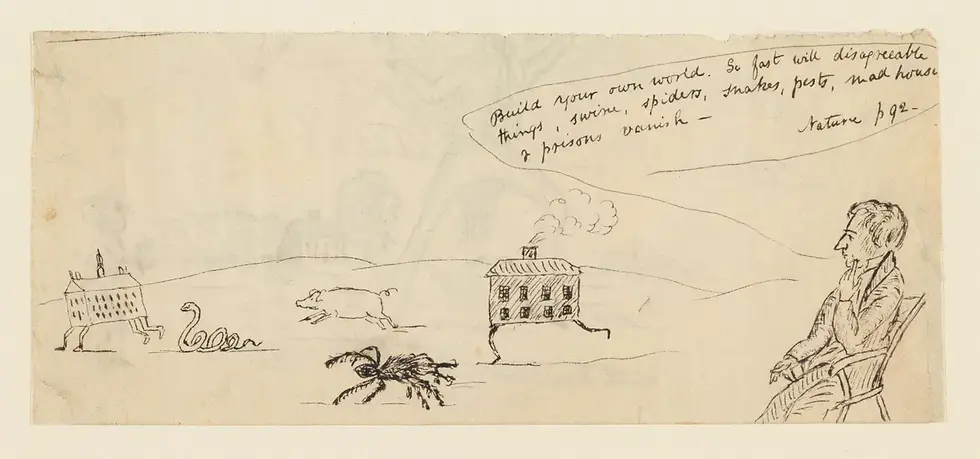
“Build your own world. So fast will disappearable things, swine, spiders, snakes, pests, mad house & prisons vanish...”
-Ralph Waldo Emerson, Nature


Comments